Agriculture faces a paradox that is only intensifying: the global population continues to grow while the resources available to feed it — arable land, fresh water, and a stable climate — are increasingly constrained. Farmers are expected to produce 50 to 70 percent more food by 2050 using the same or less land, with far less water, and against a backdrop of increasingly unpredictable weather patterns. Precision agriculture, powered by AI, is the most promising answer the industry has found.
Unlike the broad-acre, uniform-application farming practices of the 20th century, precision agriculture treats every square metre of a field as a distinct entity with its own soil composition, moisture level, pest pressure, and nutrient requirement. AI platforms fuse data from drones, satellite imagery, soil sensors, weather stations, and farm equipment to generate actionable prescriptions at the sub-field level. The result is higher yield, lower input costs, and a significantly reduced environmental footprint.
The Pressure on Modern Agriculture
Water scarcity is perhaps the most urgent constraint. Agriculture accounts for roughly 70 percent of global freshwater withdrawals, and in drought-prone regions such as sub-Saharan Africa, South Asia, and parts of Canada's Prairie provinces, water availability is becoming a binding constraint on production. Simultaneously, over-application of synthetic fertilisers and pesticides is degrading soil health, contaminating waterways, and increasing input costs that are being passed through to consumers in the form of food price inflation.
Labour availability compounds the challenge. An ageing farm workforce and increasing competition for rural labour from other sectors means that farms must do more with fewer hands. Automation and AI-assisted decision-making are no longer optional additions to farm operations — they are becoming operational necessities for farms that want to remain competitive at scale.
AI for Crop Health Monitoring
One of the highest-impact applications of AI in agriculture is continuous crop health monitoring using aerial and satellite imagery. Multispectral cameras mounted on drones or carried on satellites capture images in wavelengths invisible to the human eye — particularly near-infrared — that reveal the photosynthetic activity and stress status of crop canopies with remarkable precision.
AI models trained on annotated imagery can classify crop health status across an entire field in minutes, generating heat maps that show healthy, stressed, and failing zones at resolutions of a few centimetres per pixel. Agronomists and farm managers can identify problems — nutrient deficiency, waterlogging, drought stress, or early-stage pest damage — weeks before they become visible to the naked eye and before yield losses become irreversible.
Vegetation Index Analysis
The Normalised Difference Vegetation Index (NDVI) and related indices such as NDRE (for nitrogen stress) and NDWI (for water content) provide quantitative measures of crop vigour. AI platforms generate per-field trend analysis over the growing season, comparing current readings against historical baselines and expected growth curves for the planted variety. Significant deviations from expected trajectories trigger automated alerts that prompt targeted field inspections of specific zones rather than whole-field walkthroughs.
"Farms deploying AI-driven precision agriculture platforms report yield improvements of 25–35% while cutting water usage by up to 40% — a transformative double benefit."
Precision Irrigation: Doing More with Less Water
Irrigation scheduling has historically been managed by rules of thumb — irrigate when the crop looks stressed, when a fixed number of days have passed, or when a single representative soil probe reads below a threshold. These approaches consistently over-irrigate some areas while under-irrigating others, wasting water and promoting root disease in wet zones while allowing yield drag in dry ones.
AI-driven irrigation platforms replace these heuristics with continuous, spatially-resolved decision-making. Soil moisture sensors distributed across the field provide real-time readings at multiple depths. Evapotranspiration models fed by local weather station data — temperature, humidity, wind speed, solar radiation — calculate the water demand of the crop hour by hour. AI integrates these data streams with satellite-derived crop canopy estimates to generate variable-rate irrigation prescriptions that deliver exactly the right amount of water to each zone.
- Variable-rate drip and pivot control: Smart irrigation controllers receive AI-generated zone prescriptions and adjust application rates automatically without requiring operator intervention
- Predictive scheduling: AI models incorporate 5–7 day weather forecasts to pre-empt rain events, avoiding irrigation when rainfall will meet crop demand
- Stress detection integration: Thermal imaging identifies areas where crops are transpiring less than expected — an early indicator of heat stress — allowing immediate irrigation response
Early Pest and Disease Detection
Pest and disease management is one of agriculture's most costly and environmentally damaging practices when handled reactively. Farmers applying pesticides on a calendar schedule, or waiting until visible damage appears, consistently over-apply chemicals and miss the treatment window that would have been most effective. AI platforms shift this to a predictive, targeted model.
Computer vision models trained on thousands of annotated images of specific crop diseases and pest damage patterns can identify early-stage infections and infestations from drone imagery before they spread. A model trained to recognise early-stage wheat stem rust can flag affected zones within a field when lesion coverage is less than 1 percent — far earlier than the 5–10 percent threshold at which visual inspection typically reveals the problem. This early detection window allows targeted application of the appropriate treatment to affected zones only, reducing chemical inputs and improving efficacy.
Integrated pest management (IPM) platforms combine AI detection with trapping network data, weather-based flight and infection risk models, and crop growth stage information to predict outbreak risk before it materialises — enabling preventive action rather than corrective response.
See how KenAgri delivers precision intelligence across farm operations
Explore KenAgri →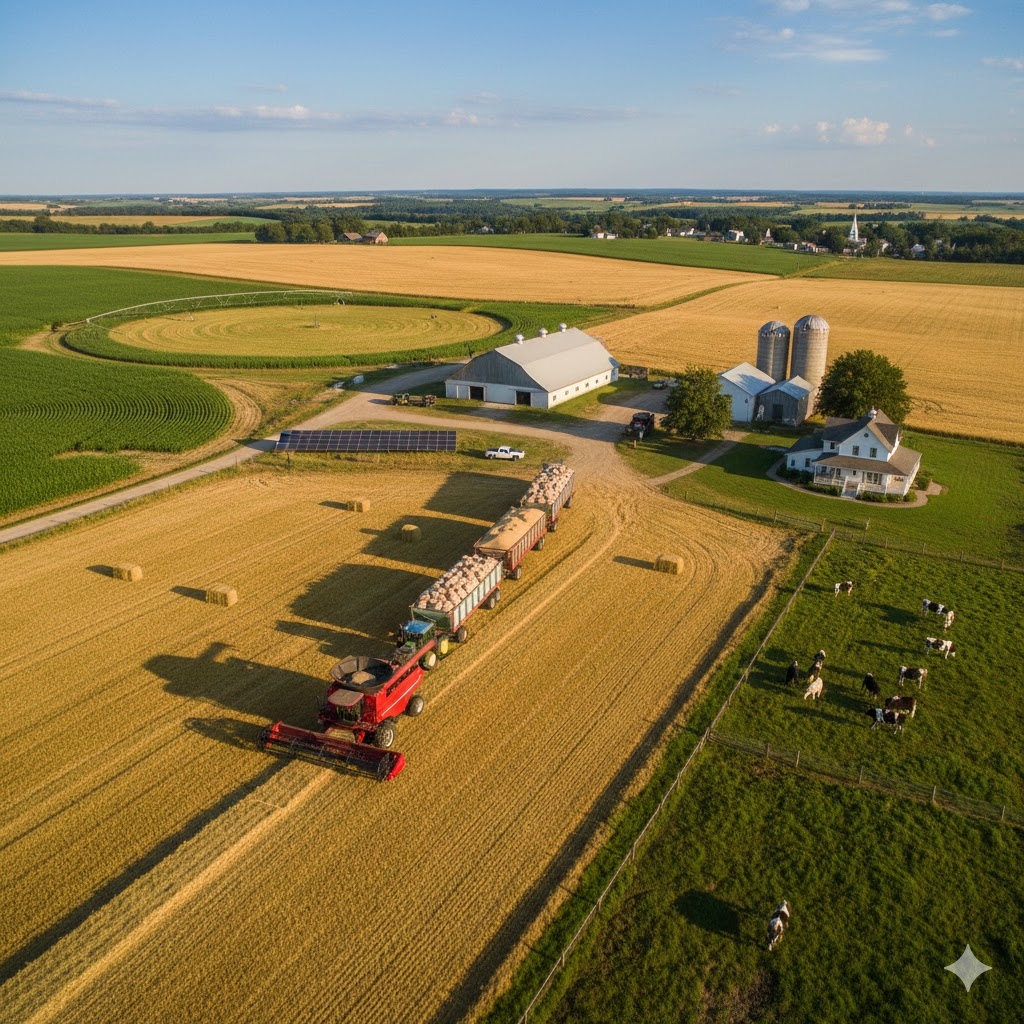
AI-Driven Farm Management at Scale
For large agricultural operations managing thousands of hectares across multiple sites and crop types, the real value of AI extends beyond individual field decisions to enterprise-level intelligence. Farm management platforms integrate all data streams — field sensors, drone imagery, equipment telematics, market data, and weather forecasting — into a single operational view from which managers can make better resource allocation decisions.
- Yield forecasting: AI models trained on historical yield data, satellite imagery, and weather records generate in-season yield forecasts at the field level up to 12 weeks before harvest, enabling better marketing and logistics planning
- Input prescription maps: Variable-rate application prescriptions for fertilisers, lime, and crop protection products are generated automatically from soil sampling results, crop monitoring data, and agronomic models, reducing input costs while maintaining or improving yield
- Equipment optimisation: Machine telematics combined with field condition data enable optimised timing of cultivation, planting, and harvest operations to maximise efficiency and minimise soil compaction damage
- Carbon and sustainability reporting: AI platforms aggregate input application records, soil carbon measurements, and fuel consumption data to generate auditable sustainability metrics for compliance with supply chain sustainability requirements
The farms that are adopting these platforms most successfully are not simply adding AI as a technology layer on top of existing practices — they are redesigning their operational workflows around the insights the platform provides. The shift from calendar-based to data-driven decision-making across all farm operations is what unlocks the yield and efficiency gains that precision agriculture promises.