
Retail shrinkage — the loss of inventory to theft, fraud, and administrative error — costs the global retail industry hundreds of billions of dollars annually. Traditional loss prevention relied on security guards, static cameras, and manual review. AI video analytics fundamentally changes this equation.
The Scale of the Problem
According to industry research, shrinkage accounts for roughly 1.5% of retail revenue. For a large retailer, that can represent tens of millions of dollars per year in preventable losses. The majority of shrinkage comes from external theft (shoplifting), internal theft, and vendor fraud — all of which AI systems are well-positioned to address.
Traditional camera systems capture footage but require human operators to review it after the fact. By the time an incident is flagged, the suspect is long gone. AI changes this by enabling real-time detection.
"Retailers using AI video analytics report up to 40% reduction in shrinkage within the first 90 days of deployment."
How AI Video Analytics Works in Retail
Modern AI video analytics platforms, such as KenVision, process live camera feeds using computer vision models trained on millions of annotated examples. The system can identify:
- Unusual dwell time near high-value merchandise
- Concealment behaviours such as placing items in bags or under clothing
- Unauthorized zone entry (stockrooms, back offices)
- Tailgating through access-controlled doors
- Anomalous checkout patterns that may indicate sweet-hearting or scan avoidance
See how KenVision detects retail loss in real time
Explore KenVision →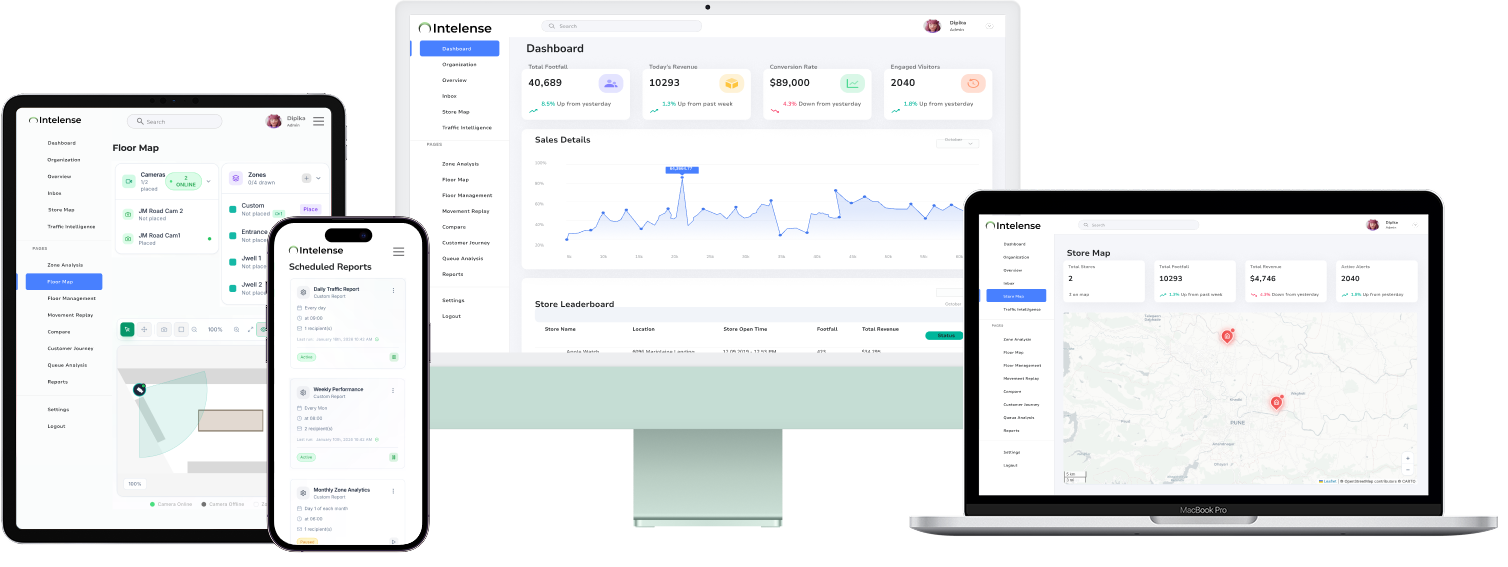
Privacy and Compliance Considerations
A common concern with AI video analytics is privacy. Properly deployed systems address this through:
Data Minimization
AI systems can be configured to analyze behaviour without storing identifiable images unless an alert is triggered. Edge processing means footage may never leave the store.
GDPR and PIPEDA Compliance
For retailers operating in Canada or Europe, compliance with PIPEDA and GDPR respectively is mandatory. Signage, data retention limits, and access controls are all part of a compliant deployment.
ROI and Business Case
Retailers deploying AI video analytics typically report a reduction in shrinkage within the first 6 months of deployment. Combined with operational benefits — automated footfall counting, queue management, and staff scheduling optimization — the business case extends well beyond loss prevention.
A well-structured AI deployment covers its cost through shrinkage reduction alone in many cases, with operational efficiency gains as additional upside.
Getting Started
If you are evaluating AI video analytics for retail loss prevention, the key questions to answer are:
- What camera infrastructure do you already have in place?
- What are your highest-priority loss scenarios (shoplifting, internal, or vendor fraud)?
- Do you need on-premise (edge) processing or are you comfortable with cloud analysis?
- What compliance obligations apply to your jurisdiction?
The Intelense team is available to walk through these questions during a no-obligation demo. Get in touch to book a session.