
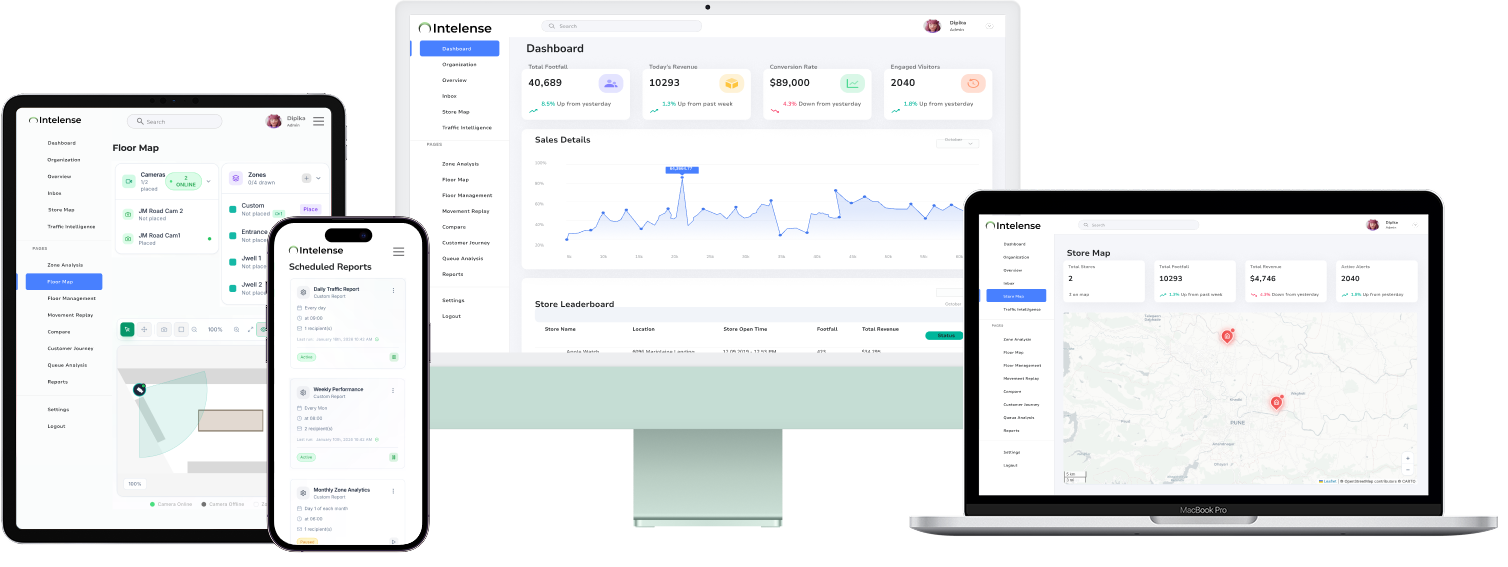
Results at a Glance
The Challenge
Traditional camera systems in malls and retail environments were fundamentally limited.
Manual Counting & Monitoring
Dependent on human effort, manual counting led to missed data, high operational costs, poor scalability, and reactive decision-making rather than proactive insights.
Lack of Granular Visibility
Retail teams had no reliable way to measure true footfall, dwell time, or zone-level movement, leaving critical customer behavior untracked.
No Actionable Business Intelligence
Cameras functioned only as surveillance tools, offering little to no operational or marketing insights, resulting in missed optimization and revenue opportunities.
Case 1: The Challenge for Shopping Malls
Modern malls manage thousands of daily visitors, but operate with limited real-time intelligence.
Blind Spots in Footfall & Flow
- Manual or sample-based counting resulted in inaccurate visitor numbers.
- No visibility into entry and exit patterns, peak congestion zones, or level-wise traffic.
- Decisions on leasing, security, and staffing were largely assumption-driven.
Reactive Operations & Security
- CCTV footage was reviewed only after incidents occurred.
- Security teams lacked real-time alerts for anomalies, overcrowding, or unusual movement patterns.
- Emergency response and crowd management remained slow and manual.
Limited Tenant & Revenue Insights
- Mall operators could not provide tenants with credible footfall and dwell analytics.
- Leasing strategies, tenant placement, and rental pricing lacked data-backed justification.
- Marketing campaigns and events were measured qualitatively, not quantitatively.
Result
Cameras existed everywhere, but intelligence existed nowhere.
Case 2: The Challenge for Retail Stores
Retail stores capture massive customer movement on camera, but almost none of it translates into insight.
No Visibility into Shopper Behavior
- Retailers had no accurate view of store footfall, repeat visits, or dwell time by zone.
- Product engagement, aisle performance, and dead zones remained invisible.
- Store layout and merchandising decisions were based on intuition, not data.
Missed Operational Optimization
- Staffing levels were fixed despite fluctuating footfall and peak hours.
- Queue build-ups and service delays were noticed only after customer dissatisfaction.
- Store managers lacked real-time alerts to act during high-impact moments.
Disconnected Marketing Measurement
- Campaigns, discounts, and in-store promotions could not be linked to actual footfall lift or engagement.
- No way to correlate store visits with time of day, external events, or marketing triggers.
- Marketing teams lacked closed-loop attribution between spend and physical-store outcomes.
Result
Stores had cameras, but no understanding of what customers were actually doing.
Why Existing Solutions Failed
Despite widespread camera deployment, existing solutions failed to deliver intelligence, only visibility.
Cameras Were Built for Surveillance, Not Intelligence
Traditional CCTV systems were designed for post-incident review, not real-time understanding.
- No native ability to detect patterns, behaviors, or anomalies
- Footage remained passive data, requiring manual interpretation
- Insights were retrospective, not actionable
Manual & Sample-Based Methods Didn't Scale
Footfall counting and audits relied on manual tracking or limited sampling.
- High operational costs and human error
- Inconsistent data across locations and time periods
- Impossible to scale across large malls or multi-store retail networks
Fragmented & Point Solutions
Existing tools addressed single problems in isolation.
- One tool for counting, another for security, another for reports
- No unified view across zones, stores, floors, or properties
- Insights lived in silos, limiting cross-functional decision-making
Hardware-Heavy, Disruptive Deployment
Many "smart" solutions required new sensors, specialized cameras, or invasive infrastructure changes.
- High upfront costs and long deployment cycles
- Operational disruption in live retail environments
- Poor ROI justification for widespread rollout
No Real-Time or Predictive Intelligence
Even advanced systems stopped at dashboards.
- No real-time alerts for congestion, queue build-up, or anomalies
- No predictive insights to anticipate peak loads or risks
- Teams remained reactive instead of proactive
Insights That Didn't Translate to Action
When data was available, it lacked context and usability.
- Reports were complex and not decision-oriented
- Operations, security, and marketing teams couldn't act on the same data
- Intelligence failed to drive measurable business outcomes
Why Retailers Have Switched
From "Pilot Projects Have Failed" to successful nationwide rollouts.
High False Positives? Solved.
Generic motion detection alerts on everything. KenVision uses Contextual AI to filter out shadows, lights, and non-threats.
Bandwidth Costs? Slashed.
Streaming 4K video is expensive. KenVision processes at the Edge, sending only metadata and critical clips.
Integration Nightmare? Gone.
No new specialized cameras needed. Works with ONVIF compliant IP cameras. Plug and play.
Privacy Concerns? Handled.
Analyzing faces risks compliance? We focus on behavior and metadata, protecting identity by default.
So, What next?
KenVision transformed existing cameras into real-time intelligence systems without changing the physical existing infrastructure.
Turned Passive CCTV into Active Intelligence
KenVision layered AI-powered computer vision models on top of existing camera feeds.
- Cameras evolved from recording devices into always-on sensing systems
- Continuous understanding of people, movement, and behavior in real time
- No dependency on manual review or post-incident analysis
Enabled Accurate, Scalable Footfall & Dwell Analytics
KenVision automated counting and tracking across every camera, zone, and level.
- Precise footfall, dwell time, and repeat-visit analysis
- Zone-wise heatmaps for stores, corridors, and common areas
- Consistent data across days, events, and locations, at scale
Delivered Real-Time Operational Intelligence
Instead of static dashboards, KenVision enabled action.
- Live alerts for congestion, queue build-up, and anomalies
- Dynamic insights for staffing, security, and crowd control
- Faster response during peak hours, events, and emergencies
Unified Insights Across Security, Operations & Marketing
KenVision broke data silos by creating a single intelligence layer.
- One platform serving mall operators, retailers, security teams, and marketers
- Correlated movement data with time, location, and activity
- Shared visibility enabled faster, better-aligned decisions
Deployed Without Disruption
KenVision worked with existing camera infrastructure.
- No new hardware or invasive installations
- Rapid deployment across live environments
- Lower cost of ownership and faster ROI
Moved Teams from Reactive to Predictive
KenVision didn’t just show what happened, it helped anticipate what’s next.
- Trend analysis and peak-hour prediction
- Early warnings for overcrowding or operational stress
- Proactive planning for campaigns, staffing, and security
Operational & Marketing Impact
Accuracy in Footfall & Movement Detection
Reduction in Manual Monitoring Effort
Faster Incident & Congestion Response
Improvement in Staffing & Resource Utilization
Increase in Marketing ROI
Increase in High-Intent Zone Engagement
Are you ready to
transform your cameras?
Explore More Case Studies
KenSafety: Construction Site Safety
How KenSafety reduced PPE violations by 95% on a major construction site using real-time AI hazard detection.
Read case study →KenHome: Family Safety AI
How KenHome AI detects falls and protects elderly residents and children using existing home cameras.
Read case study →KenAgri: Precision Farming
How KenAgri transforms farm cameras and sensors into a real-time precision agriculture intelligence system.
Read case study →